ON & OFF SET
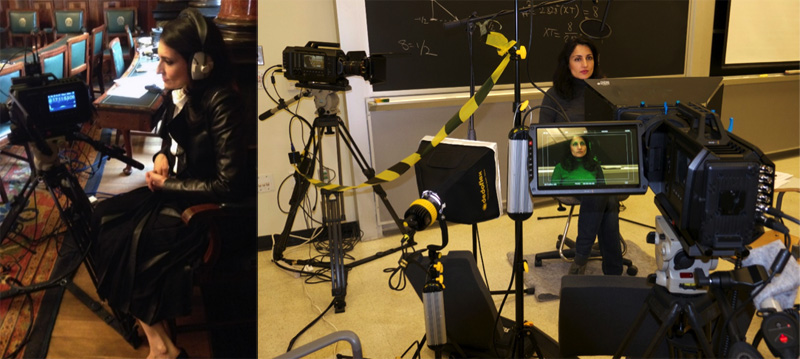
Renu Mehta is writer, presenter and executive producer of ‘Disparity' ® documentary film featuring 9 Nobel Laureates and aid industry’s leading authorities who lift the lid on Foreign Aid to shift the needle on poverty. Renu is also in production with ‘The Great and The Good’ ® series which gets up close and personal with some of the world’s most revered and successful icons who all share one defining value, serving the Greater Good. They reveal their inner secrets of success and wellbeing.
Renu has held talks with over 25 Nobel Laureates during her vocation as philanthropist and activist.
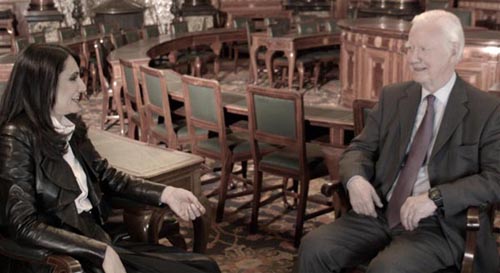 |
Renu Mehta on film set with her MM Aid Model co-author, Disparity Film co-star, long-time collaborator and mentor Sir James Mirrlees, Nobel Laureate Economist 1996.
Mirrlees is best known for his work on development economics, taxation theory, economic growth and welfare economics. He has taught at Oxford, Cambridge, MIT, & Yale and led the Mirrlees Review of Taxation, a major review of the UK tax system. |
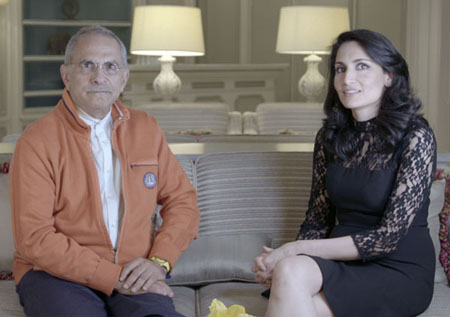
Renu Mehta on set with her Real Aid Campaign co-chair, intrepid supporter and activist, HE Dr. Jose Ramos Horta, Nobel Peace Laureate, 1996.
Before serving his country as President, he was known internationally as a peacemaker. In exile from his country for the better part of three decades, he had been the international voice of the Timorese people while they fought for survival against one of the most brutal regimes of our time. |
 |
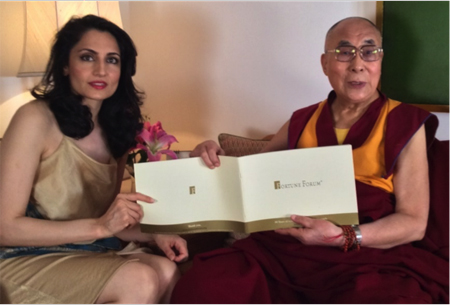 |
Renu Mehta in conversation with MM Aid Model supporter and revered icon, His Holiness, the 14th Dalai Lama, Nobel Peace Laureate 1989 on set. He is the spiritual leader of Tibet and has led the non-violent struggle for the liberation of Tibet.
He has consistently advocated policies of non-violence, even in the face of extreme aggression. His Holiness has held dialogues with heads of different religions and participated in many events promoting inter-religious harmony and understanding. |
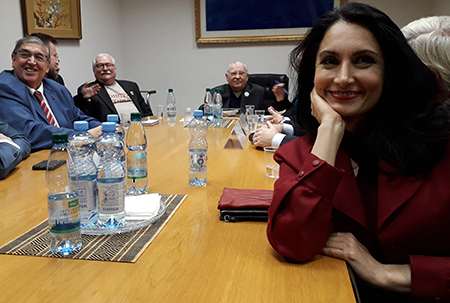
Renu Mehta attending historical roundtable meeting with the great reformer President Gorbachev, Nobel Peace Laureate 1990 and Former USSR President. During his presidency, Gorbachev implemented sweeping reforms to put an end to the totalitarian regime in the USSR; Perestroika and the openness of Glasnost. A giant of world history, Gorbachev greatly contributed to ending the Cold War, stopping the arms race and unifying Germany.
As a reaction to global problems of concern for mankind as a whole: violence and wars, problems of poverty, the ecological crisis, Mikhail Gorbachev has been President of The Gorbachev Foundation and established Green Cross International, a non-governmental environmental organization amongst others. |
 |
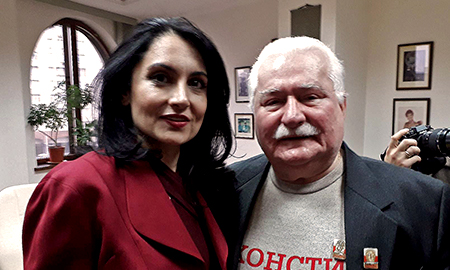 | Renu Mehta meeting the legendary leader of the "Solidarity" movement Lech Walesa, Nobel Peace Laureate 1983 and Former President of Poland. Walesa was one of the main organisers of the strike in the Gdansk Shipyard. Walesa's activity led to the realisation of the protesters demands and the first independent and oppositional social movement in the Soviet bloc. The great success of "Solidarity" led to a fierce reaction of the communist regime.
In 1995 he founded the Lech Walesa Institute. Its aim is to educate young generations and support democracy and the creation of civil society in Poland and around the world and promote the ideal of solidarity, support society democratization processes, promote a cross-cultural dialogue, and prevent human rights' abuses. |
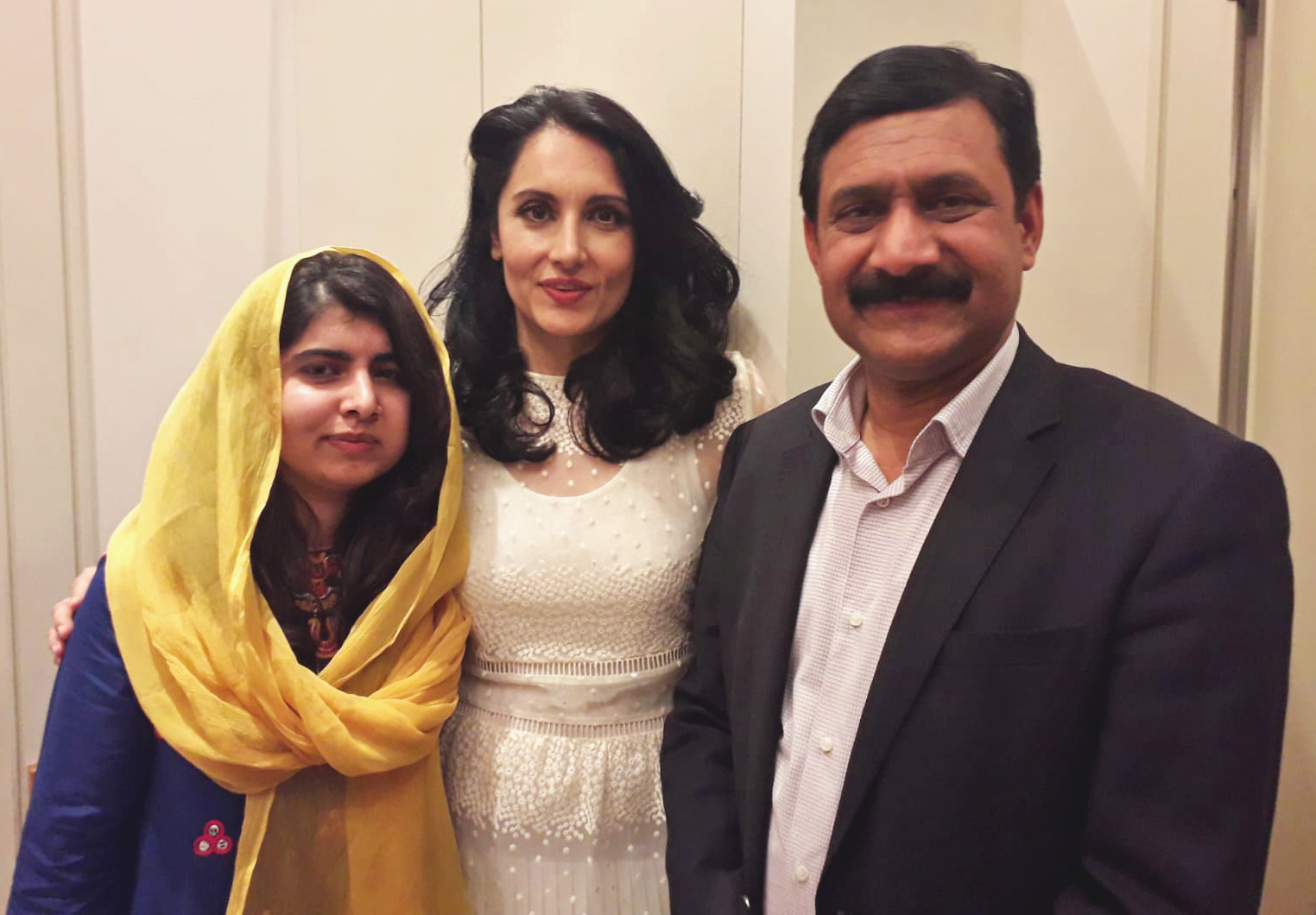
Renu Mehta with Ziauddin Yousafzai and Malala Yousafzai who became the youngest ever Nobel Peace Laureate in 2014. Malala along with her father set up the Malala Fund to continue her impassioned campaigning work dedicated to providing high quality education and equality to reach the 130 million girls who are currently out of school around the globe.
Ziauddin Yousafzai is more than the divine mentoring force behind Malala, he is a passionate advocate for gender equality and education and author of ‘Let her Fly’. |
 |
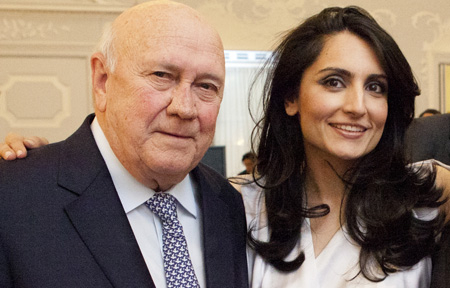 |
Renu Mehta on set with MM Aid Model Supporter FW de Klerk, Nobel Peace Laureate 1993 and Former South African President. During his presidency from September 1989 until May 1994, FW de Klerk dismantled apartheid and initiated and presided over the inclusive negotiations that led to the adoption of South Africa’s first fully democratic Constitution in December 1993.
The FW de Klerk Foundation upholds the Constitution through the work of its Centre for Constitutional Rights and promotes unity in diversity by working for cordial inter-community relations and national unity. |
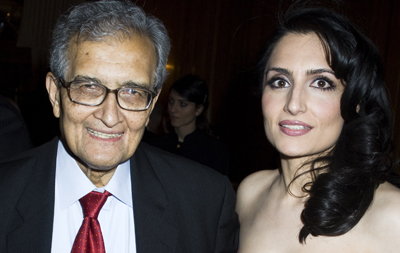
Renu Mehta in discussion with MM Aid Model supporter Amartya Sen, Nobel Laureate Economist 1998 is Thomas W. Lamont University Professor, and Professor of Economics and Philosophy, at Harvard University and was until 2004 the Master of Trinity College, Cambridge.
His research has ranged over social choice theory, economic theory, ethics and political philosophy, welfare economics, theory of measurement, decision theory, development economics, public health, and gender studies. |
 |
|
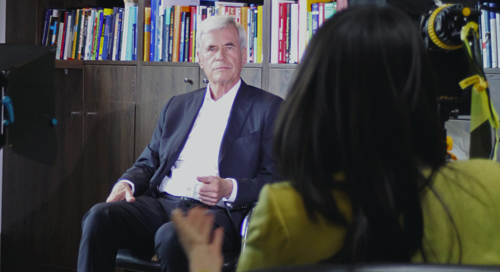
Billionaire environmentalist Dr. Michael Otto on set with Renu. Between 1981 and 2007, Dr. Otto was Chairman & CEO of the Otto Group. Under his leadership, the company developed into the largest mail order group in the world. Today the Otto Group includes 123 major companies and is present in over 30 countries and is one of the world's largest online retailers. His company has long touted environmentally safe products. In 1993, he created the Michael Otto Foundation to further multi-stakeholder dialogue on environmental issues.
Dr. Otto also founded Cotton made in Africa initiative that helps African smallholder cotton farmers to improve their living conditions and promote environmentally friendly cotton production. Working in 11 countries across Africa, the initiative has already impacted over 1,000,000 farmers and reached over 5 million families direct. |
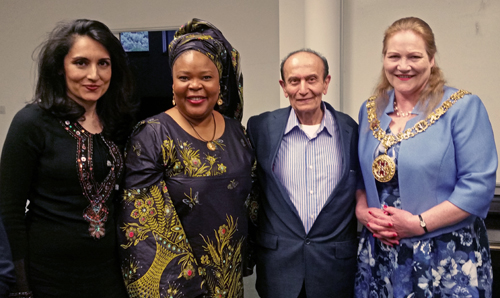
Renu Mehta chatting with Leymah Gbowee Nobel Peace Laureate 2011, Vijay Mehta & The Mayor of Winchester, Cllr Jane Rutter. Leymah Gbowee won the Nobel Peace Prize in 2011 for her work leading a women's peace movement that brought an end to the Second Liberian Civil War.
She is the founder and president of the Gbowee Peace Foundation Africa and a co-founder of the Women Peace and Security Network Africa. Her foundation provides educational and leadership opportunities to girls, women and youth as leaders and agents of change in Africa. |
|
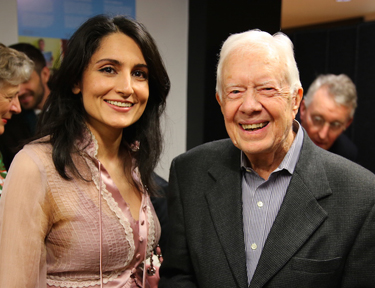 |
Renu Mehta in dialogue with Jimmy Carter, Nobel Peace Laureate 2002 and 39th President of the United States. His work spans peaceful solutions to international conflicts, advancing democracy and human rights, and promoting economic and social development.
With the Carter Center he has engaged in global conflict mediation and has spearheaded the international effort to eradicate Guinea worm disease, which is poised to be the second human disease in history to be eradicated. |
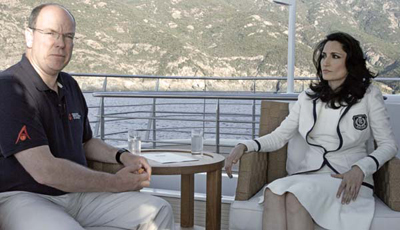
Renu Mehta on filming location with His Serene Highness Prince Albert II of Monaco. The Prince Albert II of Monaco Foundation is dedicated to the protection of the environment and the promotion of sustainable development on a global scale.
The Foundation supports initiatives of public and private organizations, in the fields of research and studies, technological innovation and socially-aware practices. Specifically, to limit the effects of climate change and promote renewable energies, to safeguard biodiversity; and to manage water resources and combat desertification. |
|
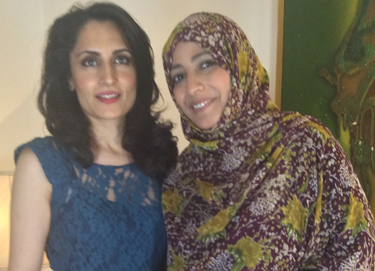 |
Renu Mehta on set with Tawakkol Karman, Nobel Peace Laureate 2011. Known as “The Mother of the Revolution” in her native Yemen.
She was awarded the Nobel Peace Prize in recognition for her work at the forefront of the struggle for human rights and women’s participation in peacebuilding in her country for years, organizing non-violent protests that swelled in size and became part of the 2011 Arab Spring movements. |
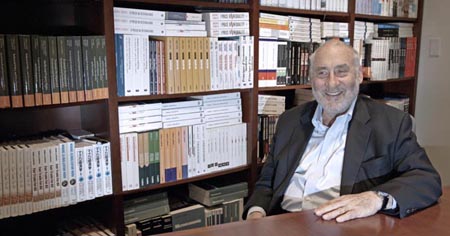
Prof. Josesh Stiglitz, Nobel Laureate Economist 2001 on the set, Columbia University. Based on academic citations, Stiglitz is the 4th most influential economist in the world today. Known for his pioneering work on asymmetric information, Stiglitz's work focuses on income distribution, asset risk management, corporate governance, and international trade.
He is a former senior vice president and chief economist of the World Bank and a former member and chairman of the (US president's) Council of Economic Advisers. In 2000, Stiglitz founded the Initiative for Policy Dialogue, a think tank on international development based at Columbia University. |
 |
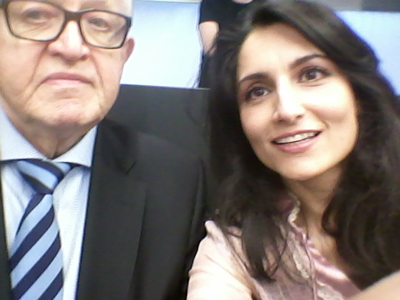 |
Renu Mehta in talks with Martti Ahtisaari, Nobel Peace Laureate 2008, Former President of Finland and expert in international peace mediation, diplomacy and post-conflict state building.
Ahtisaari was a major contributor when Namibia achieved independence in 1989-90, arbitrated in Kosovo in 1999 and 2005-07, and helped to bring the long-lasting conflict in the Aceh province in Indonesia to an end in 2005. |
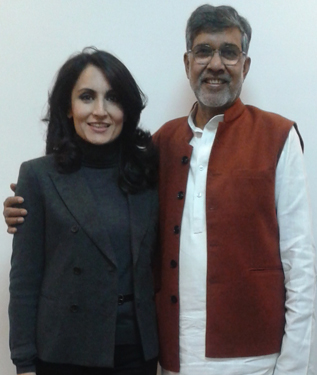
Renu Mehta with her dinner host Kailash Satyarthi, Nobel Peace Laureate 2014 who has been at the forefront of the global movement to end child slavery and exploitative child labour since 1980.
Mr Satyarthi and the grassroots movement founded by him, Bachpan Bachao Andolan (Save the Childhood Movement), has liberated more than 84,000 children from exploitation and developed a successful model for their education and rehabilitation. |
 |
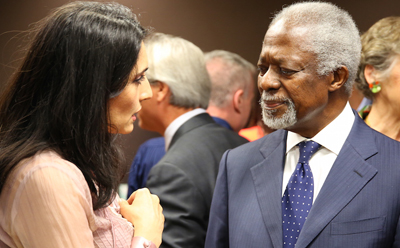 |
Renu Mehta chatting with Kofi Annan, Nobel Peace Prize laureate 2001, was the Secretary-General of the United Nations between 1997 and 2006 and the founding chair of the Kofi Annan Foundation.
With the Foundation, Kofi Annan seeks to mobilise political will to overcome threats to peace, development and human rights and supports Mr. Annan’s preventive diplomacy and mediation activities. |
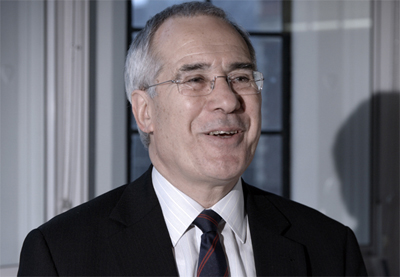
Lord Stern and MM Aid Model supporter on set. Since 2007 he has been the IG Patel Professor of Economics and Government, and also Chair of the Grantham Research Institute on Climate Change and the Environment at the London School of Economics and Political Science.
As head of the Government Economic Service, he led the ground-breaking Stern Review on the economics of climate change, published in 2006. He has been Chief Economist of the EBRD and of the World Bank and has served as adviser to governments, businesses and NGOs in many countries and as Second Permanent Secretary of the UK Treasury. |
|
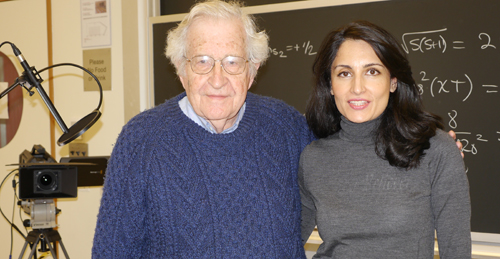 |
Prof. Noam Chomsky and MM Aid Model supporter on set with Renu Mehta at MIT. Noam Chomsky is a US political theorist and activist, and institute professor of linguistics at the Massachusetts Institute of Technology (MIT).
Besides his work in linguistics, Chomsky is internationally recognized as one of the most critically engaged public intellectuals alive today. Chomsky is also well-known as a leftist activist and social critic. He was an outspoken opponent of the Vietnam War and has remained critical of American foreign policy, media coverage of politics. |
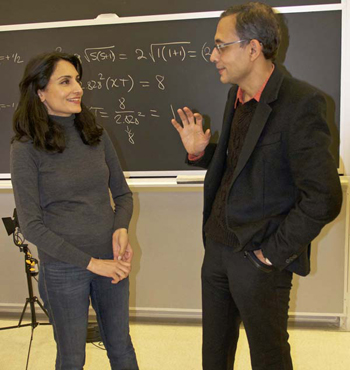
Renu Mehta on set with Prof. Abhijit Banerjee, Nobel Laureate for Economics 2019. He is currently the Ford Foundation International Professor of Economics at the Massachusetts Institute of Technology.
In 2003 he founded the Abdul Latif Jameel Poverty Action Lab (J-PAL), along with Esther Duflo and Sendhil Mullainathan and remains one of the directors of the lab. In 2011, he was named one of Foreign Policy magazine's top 100 global thinkers. His areas of research are development economics and economic theory. |
 |
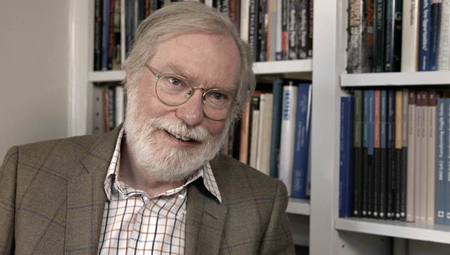 |
On set, Sir Paul Collier is Professor of Economics and Public Policy at the Blavatnik School of Government, Oxford University.
His research covers the causes and consequences of civil war; the effects of aid and the problems of democracy in low-income and natural resources rich societies; urbanization in low-income countries; private investment in African infrastructure and changing organizational cultures. |
Renu Mehta on set with Kerry Kennedy, president of Robert F. Kennedy Human Rights. For more than thirty years, Ms. Kennedy has devoted herself to the pursuit of equal justice, the promotion and protection of basic rights, and the preservation of the rule of law.
She has worked on a range of issues, including children’s rights, child labor, disappearances, indigenous land rights, judicial independence, freedom of expression, ethnic violence, impunity, and the environment. |
|
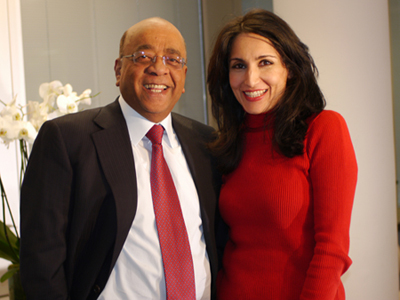 |
Renu Mehta on set with telecoms billionaire and philanthropist Dr. Mo Ibrahim. The Mo Ibrahim Foundation is an African foundation, established in 2006 with one focus: the critical importance of governance and leadership in Africa.
It is their belief that governance and leadership lie at the heart of any tangible and shared improvement in the quality of life of African citizens. |
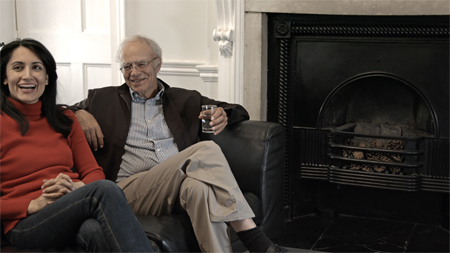
Renu Mehta on set with Prof. Peter Singer, Ira W. DeCamp Professor of Bioethics in the University Center for Human Values at Princeton University.
The Life You Can Save, based on his book of the same name, is a nonprofit devoted to spreading my ideas about why we should be doing much more to improve the lives of people living in extreme poverty. |
|
|
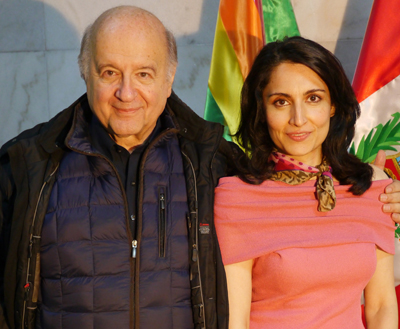
Renu Mehta on set with Peruvian economist, Hernando de Soto who is currently President of The Institute for Liberty and Democracy (ILD) which is considered by The Economist as one of the two most important think tanks in the world.
ILD works with developing countries to implement property and business rights reforms that provide the legal tools and institutions required for citizens to participate in the formal national and global economy.
|
ARCHIVE 2007-2009
“I would like to share with you some of my personal inspirations; luminaries from the many fields of global development. I have had the privilege to hear them deliver their messages; messages that they have tirelessly campaigned for,
and passionately for most of their lives…. I have had the privilege to be touched by their powers to transform perceptions, to save and improve lives and to captivate the aspirations of others with the utmost humility.... I have also had the privilege of sharing the Fortune Forum story with them…” Renu
|
|
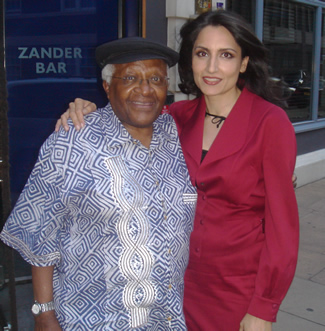
Renu Mehta meeting with Archbishop Emeritus Desmond Tutu Nobel Peace Prize Laureate 1984, her favourite living moral icon, 14th July, 2009
The distinctive values and practices that brought a peaceful transition to post Apartheid South Africa, including reconciliative and restorative rather than retributive justice, are the cornerstones of the teachings of Archbishop Tutu, winner of the Nobel Peace Prize in 1984 and former Chairperson of South Africa's Truth and Reconciliation Commission.
Archbishop Tutu articulates that the main lesson learnt from this process was that "all human beings are fundamentally good". Despite the most horrendous atrocities committed, "people amazed the world with the exhibition of their magnanimity, their generosity of spirit, their willingness not to seek revenge and retribution, but to be willing to forgive".
The Desmond Tutu Peace Centre (DTPC) plays a unique role in building and leveraging the legacy of Archbishop Tutu to enable peace in the world. Archbishop Tutu is also Chairman of the Elders and continues to work energetically in a number of areas; human-rights and his ministry.
|
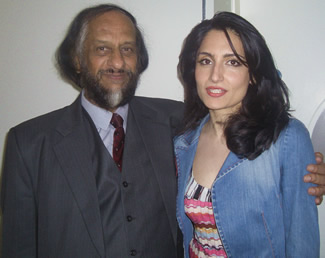
Renu Mehta meeting with Dr. Ragendra Pachauri, Nobel Peace Prize Laureate 2007, 16th July 2008
Dr. Ragendra Pachauri is an environmental scientist and economist who has served as the chair of the UN Intergovernmental Panel on Climate Change (IPCC) since 2002. Pachauri is also director general of TERI (Tata Energy Research Institute) in New Delhi, an institution devoted to researching and promoting sustainable development. Pachauri has repeatedly emphasised his concerns regarding the implications of climate change for the world’s poorest nations. To honour his contributions to the environment, he was awarded the Padma Bhushan, India’s highest civilian award, in January 2001. Dr. Pachauri accepted the Nobel Peace Prize on behalf of the IPCC, along with co-recipient Al Gore.
|
|
|
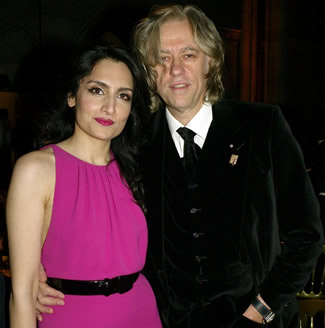
Renu Mehta with Sir Bob Geldof, 30th November, 2007
Sir Bob Geldof is an Irish singer, songwriter, actor
and political activist. Geldof,
after reacting to a news report about starving children
in Ethiopia mobilised the
pop world and released a single (‘Do They Know it’s
Christmas’) which became
the UK’s fastest selling record of all time. He
organised LiveAid, a mammoth
musical event staged simultaneously in London, UK and
John F. Kennedy
stadium in Philadelphia, USA and it raised $100 million
for famine relief. In
2004, Tony Blair appointed him for the Commission for
Africa which took a year
long study of Africa’s problem and came to the
conclusion that Africa needed to
change; to improve its governance and combat corruption
so that the rich world
needed to support that change in new ways. That meant
doubling aid, delivering
debt cancellation, and reforming trade rules.
.jpg)
Renu Mehta meeting with Former Prime Minister Gordon Brown,
19th November,
2007
Gordon Brown is the Prime Minister of the UK. Prior to which
he was the Chancellor of the Exchequer for 10 years, the longest
serving chancellor of the 20th century. Among his achievements
in particular are presiding over "the longest ever period of
growth",
making the Bank of England independent. His moral voice has
galvanized
action on tackling poverty, especially child poverty, addressing
climate
change in Africa and the developing world. His bold plan to
tackle these
issues ahead of the G8 Summit in 2005 in Scotland where he
called
for a doubling of European aid by 2010 and 100% debt relief, as
well as an end to many trade subsidies was an heroic effort.
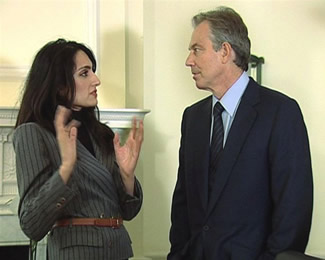
Renu meeting with Former Prime Minister Tony Blair, 13th
November, 2007
Tony Blair was the Prime Minister of the UK from
1997-2007 and presided
over three election victories, and became the Labour
Party’s longest serving
prime minister. Blair is credited for moving the Labour
Party towards the
centre of British politics, using the term New Labour.
His contribution
towards assisting the Northern Ireland Peace Process by
helping to
negotiate the Good Friday Agreement after 30 years of
conflict is widely
recognised. Tony Blair set up the Africa Commission,
which provided the
intellectual framework for a ‘big push’ on Africa. It
recommended doubling
aid by 2010, from $50bn to $100bn, of which an extra
$25bn for Africa, along
with a deal on debt and agreement on trade and
universal access to
treatment for HIV/AIDS and Malaria.
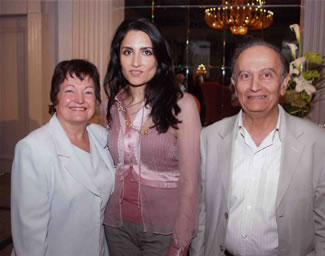
Renu & Vijay Mehta meeting with Mairead Corrigan, Nobel Peace Laureate 1976
5th October, 2007
Mairead Corrigan co-founded with Betty Williams an organisation
of the Community of Peace People, in Northern Ireland. She
became a peace
activist after three of her sisters children were killed by a
car driven by an IRA
hitman. She received the Nobel Peace Prize in 1976, along with
Betty Williams,
for their efforts to bring peace between Republican and loyalist
factions.
Corrigan believes the most effective way to end violence was not
violence
but re-education.
.jpg)
Renu
Mehta meeting Dr. Muhammad Yunus, Nobel Peace Laureate 2006
28th March, 2007
Professor Muhammad Yunus is internationally recognized for his pioneering
work in poverty alleviation and the empowerment of poor women that has
inspired a global microcredit movement. He founded the Grameen Bank
which today lends out half a billion dollars a year, to the poorest of the poor,
including beggars, while maintaining a repayment rate of 99% of poor women in
all five continents, in poor countries as well as rich. He received the 2006 Nobel
Peace Prize.
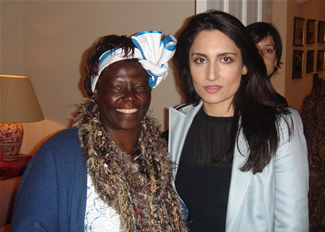
Renu Mehta
meeting Prof. Wangari Maathai, Nobel Peace Laureate 2004,
10th February, 2007
In 1976, she introduced the idea of planting trees with
communities. She established the Green Belt Movement (GBM) in
1977, initially to address deforestation. Later the issues of
community empowerment and
environmental conservation were
incorporated. To date, over 30 million
trees have been planted,
primarily by women, across Kenya. In addition,
GBM has been
responsible for bringing the environmental agenda into
mainstream politics. She and the GBM received the 2004 Nobel
Peace Prize.
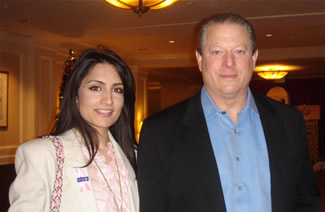
Renu
Mehta meeting The Hon. Al Gore, Nobel Peace Laureate 2007
8th December, 2006
Former Vice President Al Gore has been the leading
advocate for confronting
the threat of global
warming. His pioneering efforts were outlined in
his best-
selling book Earth in the Balance:
Ecology and the Human Spirit (1992) and
later in ‘An
Inconvenient Truth’, and the subject of the movie of the same
title.
The film received an Oscar for best documentary in 2007.
He is the architect of
Live Earth; 7 concerts are to be
simultaneously staged on all 7 continents on
07/07/07 to raise international awareness.
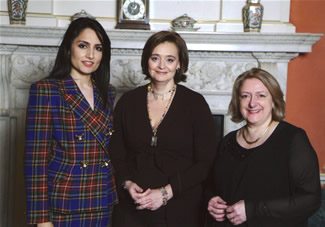
Renu Mehta meeting Cherie Booth QC, 6th December, 2006
Cherie Booth QC is a barrister and the wife of the British Prime
Minister
Tony
Blair. Cherie actively endorses many charitable organisations and in
doing
so
has championed women's rights, children, medical, legal, arts &
culture, religious and
racial equality issues amongst others. Cherie Booth is an
internationally renowned human rights campaigner
and is Patron of Rights and Humanity. She is
pictured here with the President
of Rights and Humanity, Julia Häusermann at 10 Downing Street .
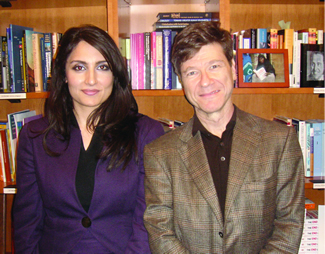
Renu Mehta meeting Prof. Jeffrey Sachs, 13th
November, 2006
Professor
Jeffrey D. Sachs is the Director of The Earth Institute, Director of
the
UN Millennium Project and Special Advisor to United Nations
Secretary-General
on the Millennium Development Goals. He advises
governments around the
world on economic reform and works with
international agencies to promote
poverty reduction, disease control
and debt reduction. He is author of hundreds
of scholarly articles
and many books. He is pictured here at Columbia
University.
Renu visits the Geneva headquarters of the
International Red Cross and Red Crescent Movement on 1st June,
2007
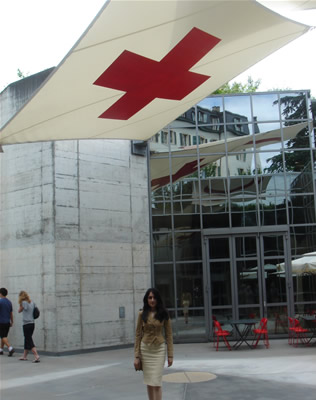 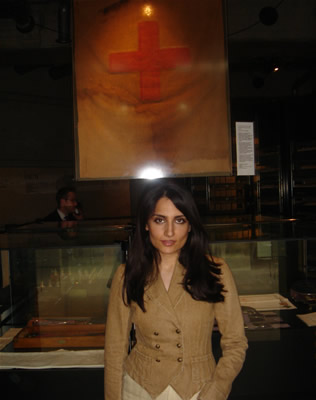
"Visiting The Red Cross Museum was, for me, itself an historic humanitarian experience; an experience that encapsulated many of history's misfortunes. It narrated how, in order to surmount some of the very cruellest of challenges, a truly great organisation was born. The power of this experience was held in the sequence of Nation upon Nation joining this movement to follow man's common ideals whilst transcending cultural bridges to become, what is today, a super 185 nation member organisation.
The Red Cross global composition goes much deeper to a local level that comprises of an intricate
structure which delivers both aid relief and development work. In addition to their work to ensure humanitarian protection, first aid and assistance for victims of war and armed conflict, it carries out relief operations to assist the victims of disasters and works to strengthen the capacities whilst promoting humanitarian values.
The Red Cross have led the way to provide vital life saving initiatives and long-term solutions to tackle global poverty, climate change and diseases; HIV/Aids and Malaria, the very areas in which Fortune Forum was set up to address. In working with The British Red Cross, we aim to highlight these development initiatives to not only contribute to these efforts, but to express why Fortune Forum feels so extremely proud to be working with The Red Cross Movement - the largest humanitarian organisation in the world."
Renu
The Red Cross Museum & History Highlights
The museum displays the history of the Red Cross Movement up until the present day. Using documents of the era, a panoramic slide show reconstructs the battle of Solferino in 1859 in which 40,000 men were killed or wounded in a single day as the French and Peidmontese
drove the Austrians out of the north of Italy. Arriving at the aftermath of the battle, Henry Dunant, a businessman from Geneva, was horrified to
find the wounded soldiers lying abandoned on the field and he mobilised the local population to provide relief.
On his return from Geneva, Henry Dunant wrote "A Memory of Solferino", in which he proposed that states should "formulate some international principle, sanctioned by a convention, inviolate in character, which, once approved and ratified, might serve as the basis for societies for the relief of wounded". The International Committee for the relief of wounded soldiers (precursor to the Red Cross) was established and drew up the First Geneva Convention. The museum displays this original Geneva Convention and the first ever Red Cross flag (pictured
above).
During the First World War, the Red Cross worked to protect prisoners of war. A display of case upon case of seven million card files powerfully demonstrates the efforts of the Red Cross to find prisoners of war and maintain contact with their families. During the Second World War the Red Cross delivered 120 million messages between families separated by conflict.
It was hard not to be deeply affected by the representations of the current activities of the Red Cross around the world, including orthopaedic rehabilitation centres for the victims of landmines and a display of walls of photographs of children separated from their parents in Rwanda. 90% of these unaccompanied were subsequently united with their parents.
A series of inscriptions runs the entire length of the of the museum wall, marking every year from the foundation of the Red Cross. Beneath every single year a long list of wars, disasters and epidemics were recorded. The wall served as a moving and stark reminder of why the
work of the Red Cross is as relevant today as it has been for the last 150 years. Since the founding of the Red Cross there have been just six
days of peace.
For more information on the history and origin of the Red Cross Movement visit www.redcross.org.uk/standard.asp?id=40164&cachefixer=
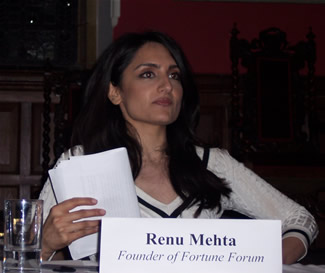
Renu addressed the Oxford Union on 29th May, 2007. She joined a distinguished panel which sparked a lively debate with many philanthropists to-be and a growing number of students embarking on social-enterprise careers within the audience. Renu's address below
preceded a number of stimulating questions from the floor directed to the panel.
Debate topic: "Fortune Forum - Is business intervention
the most effective solution to poverty?"
Speakers:
Renu Mehta – Fortune Forum
Sir Tom Hunter – Hunter Foundation
Sir Stelios Haji-Ioannou – Easy Group
Craig Sams – Green & Blacks
Dr. R.S. Ram – Wings of Hope
Smruti Sriram – Treasurer Oxford Union
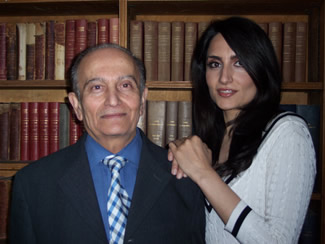
Renu is pictured here with her inspiration and author of
the Fortune Forum Code Book, her father, Vijay Mehta
"I am privileged to be here and for the Fortune Forum to have been chosen as the inspiration of this debate.
President and members of the Oxford Union, I am sure that my fellow speakers would all agree that this subject that we are about to discuss is of the utmost importance not only to the shareholders and customers of businesses but to the global conscience at large.
We live in moral poverty if we cannot free the needs of the poor.
It is especially appropriate, I think, that such a discussion takes place before the Oxford Union, an audience of tomorrow’s leaders and visionaries who are able to create and implement ethical standards into what would surely become tomorrow’s norm.
I am not speaking here today as a campaigner.
Activists, NGO campaigns and media attention have long held companies to account and this has pushed government regulation so we have surpassed the sphere of campaigning. Rather this has now become a global issue that needs to be dealt with by, not only the government, but corporations and consumers alike.
We in the West are seeing some great advances in technology, innovation and communication. However, the disparity between the rich and the poor has increased to the most disproportionate levels in history, not because the rich are getting richer but because sadly the poor are getting poorer. In many regions of the world, women walk for miles and hours each day to collect this - water, water which comes to us, each and everyone one of us,… on tap.
For those barely surviving, as half the world’s population does on less than $2 per day, face the grim problem of existence against disease and hunger. Only an out-of-touch corporation would deny the hopes of the thousands of children who die each day. This is not just a problem for humanity, but for businesses at least enlightened enough to see their own self- interest in developing wealth in the 3rd world. To change the world rests not only on the corporations shoulders but rests on the collaboration between philanthropy, development agencies and public and private sectors alike.
I am not speaking here today as a campaigner but rather as a convener.
Fortune Forum brings together global leaders, influential entrepreneurs, heads of foundations, high net worth individuals and NGO’s to bring their ideas, influence and resources together to tackle the interrelated issues of global poverty, climate change and deadly diseases.
So, in a line, Fortune Forum is about the fortunate helping the unfortunate.
 We too have responded by setting up a hybrid model that has the financial We too have responded by setting up a hybrid model that has the financial
prospects of business but has philanthropy interwoven in it. I am delighted to
publicly announce here today at this Oxford Union address, the launch of ICE
Circle, International Clean Energy Circle; an initiative to deepen our commitment
towards tackling climate change. We will present for-profit and not-for profit
initiatives to both entrepreneurs and philanthropists alike. In doing so, they can
expect a financial return as well as make an environmental impact.
The people who will be most affected by climate change are those living in the
developing world. 2 billion people currently do not have access to energy
services. We will provide investment opportunity which address environmental
problems at both the global and local level.
For example, we have partnered with a carbon offsetting organisation,
Envirotrade based in Mozambique. Whilst corporations make their carbon
offsets, they can also address issues of poverty and bio-diversity
simultaneously, as the money from sales of these carbon credits gets
ploughed back to help some of the poorest communities
Africa. ICE Circle and
Envirotrade are two
examples of altruism and capitalism co-existing."

“I recently made
a visit to Ethiopia to see the type of work that is
being
implemented by WaterAid; the type of projects that will be
funded by
Fortune Forum’s donors around the globe. This visit
left me with a profound sense of purpose and a renewed spirit to
re-address the
issues related, not only to water shortages but to
the inter-related
issues of hunger and disease. I hope that you
we will be moved as
much as I have been, after reading my
diary piece…. to do more…….”
Renu
CLEAN WATER FOR ALL
by Renu Mehta
Departing from Heathrow, I shifted my delirium of the Fortune Forum launch event to the back and glamorous part of my mind.
In September 2006, Former US President Bill Clinton, actor and UN Messenger for Peace, Michael Douglas and the spiritual guru, Deepak Chopra all participated with the legendary Yusuf Islam (formerly Cat Stevens), performing his first major live performance in over 28 years,
launched Fortune Forum. At the event, the interdependent issues of global poverty, climate change and deadly diseases were highlighted by showcasing the work of WaterAid, The British Red Cross, African Renaissance, Alliance for a New Humanity
and Small Kindness all on a shared platform.
Fortune Forum
was founded in 2006 upon being motivated
after learning of the brutal statistics and the horrifying conditions prevalent in the developing world. I first realised the importance of the global water problem when I had seen a WaterAid TV commercial which blatantly stated that 1.1 billion people live without access to safe clean drinking water and 2.6 billion people live without adequate sanitation around the globe.
At the event, clean water had been purchased for 7,000 people - for a lifetime, providing both sanitation and hygiene education. These measurable project lots had been
generously sponsored by some of the participating donors there. So when Paul Hetherington, Communications Director of WaterAid called me to ask if I wanted to join him on a trip to Addis Ababa, Ethiopia to see the type of work that Fortune Forum is helping to address by way of supporting WaterAid’s global efforts, I immediately grabbed a visa.
Whilst I was
initially inspired to act upon merely a broad comprehension of
the ‘paper issues’ so far, my journey had been, no doubt, a
vicarious one. This was an opportunity to put expressions to the
cold facts, and faces to this mystical and ancient civilization.
This voyage would mark my first visit on the ground.
SUNDAY 17TH DECEMBER, 2006
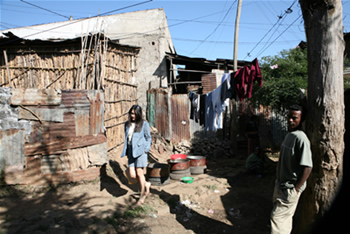
Having checked into the Hilton, Addis, after Paul had stuffed me with all the Ethiopian historical and cultural insights and armed with a suitcase full of Ralph Lauren, I was now ready to step out into Addis. What looked like a winding road to the Sheraton Hotel was a broken one with a view of vast inner city slum areas in the cracks. I wandered off to take a look. Carlos Reyes, the celebrated documentary photographer, pointed his big lens at me to capture the scene.
Juxtaposed between a washing line and sheets and sheets of corrugated iron
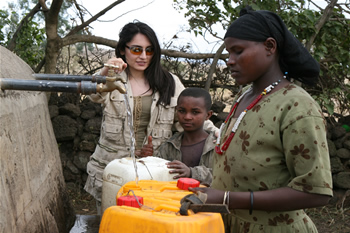
that formed the structure of dwelling and shelter for many of Addis’s poor, there was a water pump providing clean water to 500 locals. It is horrifying that 20 litres of water can be purchased (water is not freely available to the poor) for approx 25 cents.
When we ashamedly arrived at the Sheraton hotel for a good lunch, we had discovered that the owner was one of the largest producers of corrugated iron – profiting from both the rich and the poor. I wanted to see past the corrugated iron and discrimination the following day.
MONDAY 18th DECEMBER,
2006
The road out to the water installation project in Gonde felt like a familiar one – it had the semblance of
my native India; similar construction, architecture and the same kind of dust and pollution that was streaming into our Lada. Almost every image was the same, only when our car stopped at the traffic lights, child beggars knocked on the windows with their exquisite features and fine bone structure which displayed the most dignifying smiles, but that of a different heritage.
We arrived at the rural water project at Gonde and then made a short but arduous trek across a sweeping valley hugging a trickle of water drawing us closer to the water source – my journey had taken around 10 minutes. The journey, for me, was a cobbled one that required the dexterity of a tightrope walker. Now try to imagine this – a woman carrying 50lb of water on her head, only her journey would take approx. 7 hours to carry this crushing load of water to her family, robbing her of time away from work and her family.
This water installation means that clean and safe water has literally been brought to 50,000 people by 100km of pipeline which has now been installed. This
now obviates the need for the 7 hours walk which women had made on a daily basis.
TUESDAY 19TH DECEMBER,
2006
I walked into the urban inner city development and
was greeted as if were ‘The lady from Del Monte’.
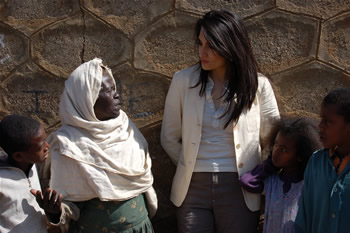
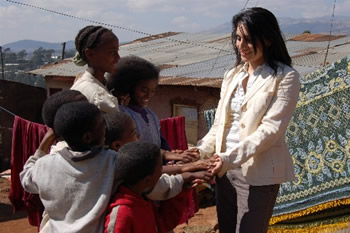
A central installation of water providing 98,000 people with clean and safe drinking water means that community life is now centred and intrinsically dependant on and around flowing clean water and fresh showers. I struck up a conversation with the water attendant Algarnesh, who told me about the loss of both her son and daughter-in-law to HIV/Aids and that she was bringing up her grandchildren. She pointed out one of her granddaughters Terese, to me with great pride.
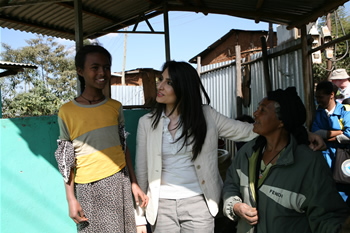
I was curious to see what was behind the corrugated iron as up until now I had only a perception.
After accepting a spontaneous invitation into her home, I was
surprised to see that there was ample but modest furniture purchased from her income from being a water attendant . Over a shockingly good cup of coffee, with a view of the adjoining bedroom complete with a wardrobe, she implored me to take her beautiful
granddaughter back with me. Although silently, I was smitten by her angelic smile that belied her rough and torn clothes, I hugged her and said that I hoped that when her daughter becomes a woman, there will be an elegant Ethiopian man waiting, who would tap her on her shoulder but belonging to more affluent times. She gave a wise smile that of a reconciled woman and said thank you for
listening.

This was a profound journey – I had now confronted my comprehension of this beautiful corner of this old but developing world. This was not extreme poverty or shock that I had encountered, but rather I was saddened by the stillness of inequity, inequity that represents almost half of humanity of
people barely living on $2 per day.
On leaving the last water installation, fortified with the determination to do more, there was a cry from the village when the lady from Del Monte proclaimed ‘Clean water for all!’
|